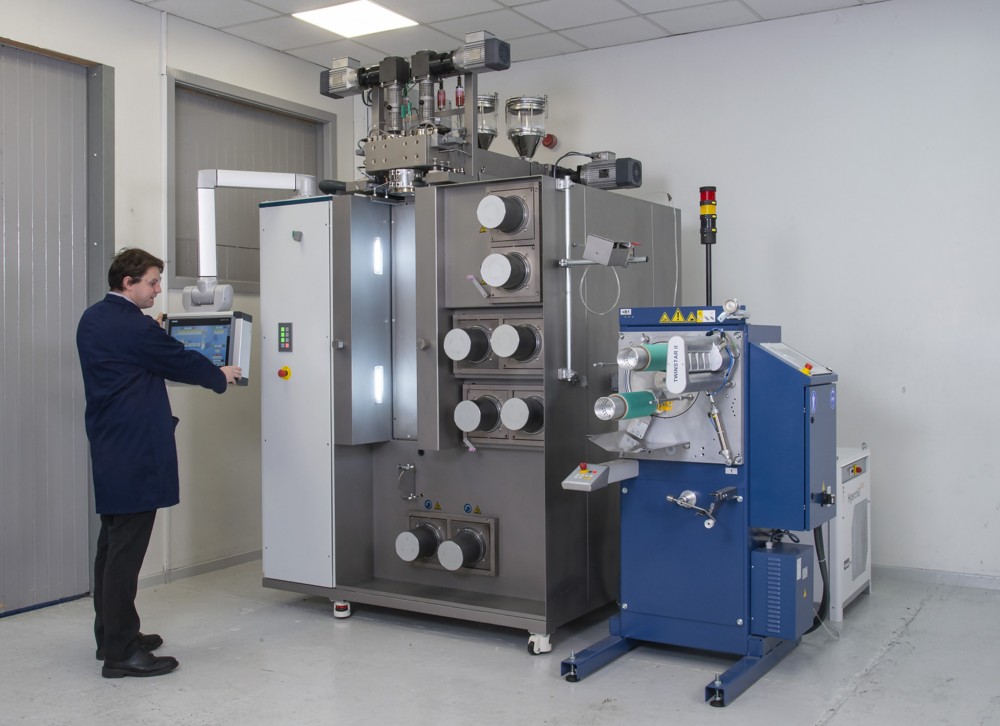
Many high-performance materials – sutures that dissolve when a wound has healed, armour that stops bullets, composites for aircraft wings – start life as polymer fibres. Leeds-based Fibre Extrusion Technology (FET) builds the spinning machines that make those fibres, melting a polymer and drawing it through precision nozzles to create fine, high-value strands that can be woven into many valuable materials.
FET’s R&D team, led by Dr Jonny Hunter, is constantly looking for ways to raise efficiency and cut waste. “Our equipment can regularly exceed 95% processing efficiencies,” says Hunter, “but we’re always looking for novel routes to squeeze out those last few percentage points.”
At the heart of fibre production is the spin pack. It works a little like a shower head: molten polymer is pumped in, then pushed through a spinneret – a metal plate with tiny holes – emerging as individual strands.
Most of the polymer flows straight through, but some can get caught in ‘dead zones’ – quiet corners inside the pack where the flow slows, and the polymer starts to break down. When it eventually reaches the nozzle, the degraded polymer can lead to faults in the finished fibre, from discolouration to weak points in strands that may snap during production. “These polymers are worth £1,000 to £15,000 a kilo,” says Hunter, “so every milligram we can save and turn into a valuable product means more revenue for the customers who use these machines, and a better business case for us.”
Yet changing spin pack design to improve flow and reduce dead zones has always involved trial and error. “A spin pack only costs a couple of hundred pounds,” says Hunter, “but it takes three months to machine it into a new design before we can see whether it performs any better.”
AMPI’s Innovation for Machinery (I4M) programme offered FET a different route to exploring new designs, using modelling capabilities they did not have in-house or in their network.
“The first thing to say is how easy it was to apply,” says Hunter. “So many grant applications take weeks to complete. I4M is designed for machinery SMEs – the whole application was a few conversations, a project outline, tweak this, tweak that, and off you go.”.rnrnWith the project agreed, AMPI matched FET with Dr Alessandro De Rosis, an expert in multiphysics modelling at the University of Manchester. Together, they built a digital twin of FET’s multifilament spin pack, which produces many fine strands of fibre at once. This virtual replica used computational fluid dynamics (CFD) – software that simulates how liquids flow – to show exactly how the molten polymer moves through the pack, and where it gets stuck.
“We did 16 virtual iterations of design changes that we’d never try in reality,” says Hunter. The most promising features were combined into a final design, which FET then had physically machined.
That success opened the door to a second AMPI-funded project, which applied the simulation approach to another fibre production product, its monofilament spinneret, which produces a single strand of polymer. To expand the potential design space, it deployed a machine learning algorithm to run the simulations, which could learn from each attempt and iteratively improve designs. Where the first round explored 16 designs, the algorithm ran around 600. From these, three designs were settled on for physical manufacture, each optimised for different materials.
The spin pack designed through the first project has since been made, tested and “delivered a 20–30% improvement in efficiency across a range of metrics,” says Hunter. That is a benefit that FET has built into the machines it sells, boosting value to customers, and FET’s competitive position.
Hunter and the Manchester team also published their findings in a peer-reviewed paper, adding trust to FET’s reputation. “Customers see this is peer-reviewed and that we’re working at a really high level,” says Hunter, “and that makes them want to work with us all the more.”
That credibility has turned into business. That credibility has turned into business. A number of customers have adopted the new spin pack designs, and are starting to see value. Others have been inspired to apply the simulation technique to their own bespoke spin pack designs, unlocking improvements of their own.
In total, the work has brought in around £150,000 of revenue FET would not otherwise have had – mostly from the medical, defence, filtration and aerospace sectors across the US, Europe and Asia.
The designs that emerged from the second project are at an earlier stage, but the team is expecting gains on a par with the first project. If reality matches the simulation, FET plans to publish again.
Summarising the work, Hunter says:
“The AMPI-funded I4M projects turned the way we design new machine components from months of trial and error into a few days of virtual testing. That has delivered real product upgrades with measured efficiency gains of 20–30%, a published paper, and new customers around the world – and we simply wouldn’t have done it without AMPI.”